The Materials Bottleneck Behind Defense Production
Defense production depends on more than factories and funding. But advanced polymers could actually streamline industrial defense capacity.

Defense spending is rising, but turning additional funding into additional production is not simply a matter of building more factories or buying more equipment.
Or as one American defense manufacturer put it, "The Pentagon's industrial-base problem is no longer a shortage of capital. It is the time required to turn that capital into qualified suppliers, suppliers into parts, and parts into weapons in warfighters’ hands.”
The point was made by James DeMuth, CEO and co-founder of Seurat Technologies, who argues that the challenge for defense companies is not necessarily finding money to invest in production but converting that investment into qualified manufacturing capacity quickly enough to meet demand.

“The next phase of rebuilding the arsenal should be measured not in dollars obligated or factories expanded, but in something much harder to game," he says. More important, he thinks, is asking, “How many additional qualified suppliers can produce critical parts, and how quickly can they begin delivering them?"
Part of the problem is that defense ministries do not consider raw material selection and the approval of cutting-edge technologies sufficiently upstream. The presence or lack of these raw materials and technologies can then influence every stage of production. This creates a critical distinction between potential production capacity and usable production capacity. A manufacturer may have the physical equipment to produce thousands of additional components, but if a critical material cannot be sourced reliably, or a substitute material has not been qualified, that capacity cannot be used.
“The qualification of a new supplier, part, or design is rigorous for a reason,” he notes. “That rigor is correct, and I am not advocating faster approvals or looser standards. Instead, the infrastructure for running that standard rigorously—meaning trained auditors, shared process control documents, and material databases—is funded like an afterthought.”
Why Polymers Are More Than Commodity Inputs
Polymers, for example, are sometimes treated as relatively straightforward manufacturing inputs. In many defense applications, however, their properties are directly connected to the performance of the finished component.

A single polymer formulation can dictate weight, stiffness, impact behavior, thermal resistance, dimensional stability, chemical resistance, electrical characteristics, durability, and processing behavior.
Yet, this creates a practical paradox: If qualification is already a major bottleneck, does introducing novel materials make the problem worse?
At first glance, altering a material specification might seem counterintuitive to speeding up production. Changing a core material in a defense platform can trigger lengthy testing and qualification cycles that take months or even years. If a new material simply adds another regulatory hurdle, it worsens the very bottleneck producers need to solve.
However, custom polymer engineering is not about changing materials for the sake of novelty. It is about strategically engineering formulations to eliminate the specific physical and supply bottlenecks halting assembly lines today.
Where Custom Polymer Engineering Makes a Difference
Off-the-shelf materials provide manufacturers with an established starting point, but they rarely offer the exact combination of properties required for high-stress defense applications—nor are they optimized for high-throughput production.
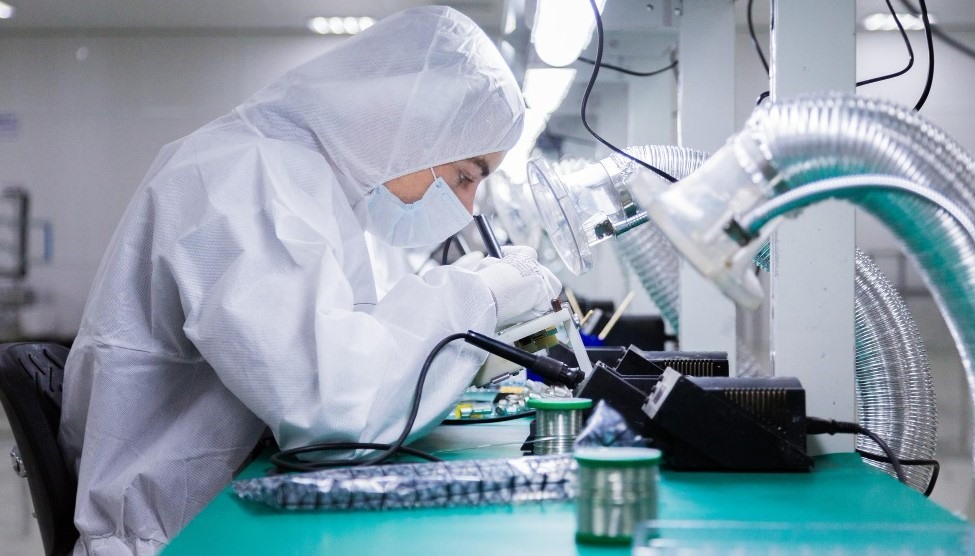
Custom polymer development and nanomodification provide a direct route to adjusting performance without discarding established platform standards. By incorporating carefully selected nanomaterials or tailoring the base polymer chemistry, engineers gain another variable to solve production constraints before they reach the factory floor.
Rather than slowing down production, custom polymer systems accelerate throughput in three key ways:
Bypassing Single-Source Raw Material Shortages: When a defense component relies on a scarce metal alloy or a proprietary resin tied to a single, backlogged vendor, production stops. Custom polymer systems can be tailored to match the precise mechanical, thermal, and chemical profile of those hard-to-source inputs, allowing manufacturers to qualify alternative domestic supply lines.
Optimizing for Faster Manufacturing: Traditional defense composites often demand long autoclave cure cycles or complex, multi-stage machining. Modern polymer formulations can be engineered specifically for high-speed processes—such as rapid-cure resins that drop cycle times from hours to minutes or specialized pellets designed for high-throughput additive manufacturing without warping.
Solving Legacy Obsolescence: Older platforms frequently grind to a halt because a sub-tier supplier no longer makes a specific seal, housing, or dampener. Custom polymers allow engineers to replicate the exact required performance characteristics in a modern, readily manufacturable material without needing to redesign the broader sub-assembly.
The Real Bottleneck Is Upstream
The expansion of defense production is often discussed in terms of factories, production lines, and procurement budgets. But the industry must look beyond how much money is being invested or how many facility footprints are expanded, as the more useful metric is how quickly that investment can be converted into qualified, repeatable, and scalable production.
Raw materials are the foundational variable in that equation.

Speed in defense manufacturing does not come from bypassing rigorous qualification standards; it comes from engineering materials that make the qualification process worth the effort.
The next expansion of defense manufacturing will not be measured only in factories and machines. It will depend on how quickly industry can develop, qualify, source, and manufacture the advanced materials those factories depend on.
Follow AG Defense Polymers on LinkedIn to gain more insights into how polymer modification is changing defense production.
Photo credit: Vecteezy, Vecteezy, Vecteezy, Magnific & Magnific