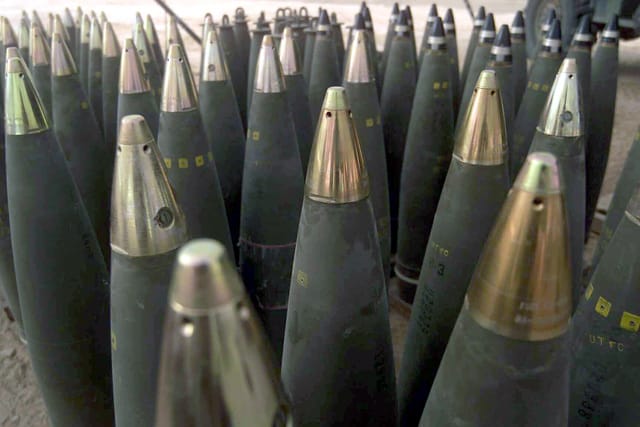
From Boats to Bullets: Where Polymers Are Transforming Military Output
How advanced polymers are making improvements to both military hardware and ammunition.

Some of the most significant changes taking place in defence manufacturing are happening to the materials from which military equipment is made. Advances in polymer science are enabling military equipment that is lighter, faster to produce, and easier to sustain in the field.
For example, a recent startup in Hawaii is illustrating this point by manufacturing large boats for the U.S. Navy using industrial-scale 3D printing.
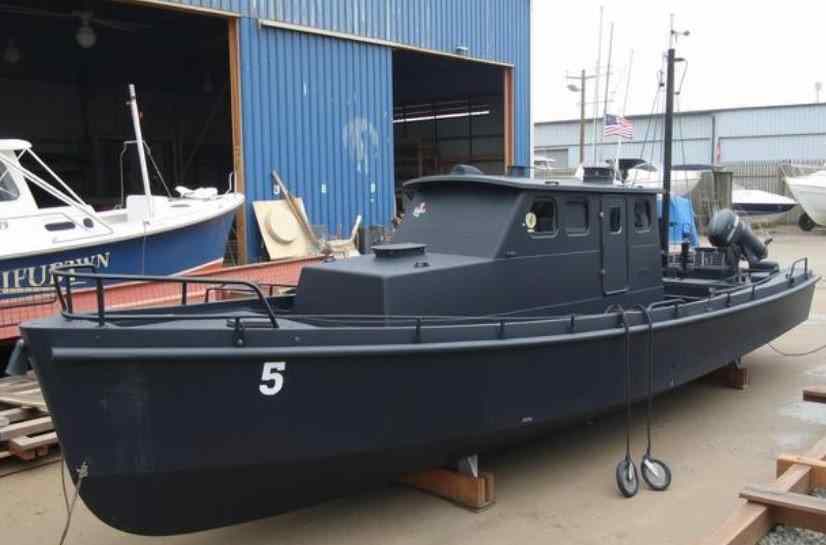
But that’s not all, because the polymers which are now being used to print boats are also finding their way into a very different military application: ammunition. Nano-enhanced polymer shell casings promise to reduce weight, lower costs, and improve safety, all while maintaining the performance demanded by modern armed forces.
These developments may seem unrelated, but together they point towards a broader shift in military manufacturing: the use of polymer feedstocks to improve production efficiency and performance.
Printing Boats Instead of Building Them
For centuries, military vessels have been built using traditional manufacturing techniques. Whether constructed from wood, steel, or aluminium, shipbuilding has generally relied on cutting, welding, machining, and assembly.
Large-format additive manufacturing and the smart application of polymers are challenging the ancient tradition of fabricating individual components and joining them together by using industrial 3D printers to manufacture a boat from plastic. Doing so dramatically reduces production time while eliminating many of the tools, moulds, and specialised facilities required at a conventional shipyard.
Advanced polymers also offer practical advantages in maritime environments, as unlike metals, they do not corrode when exposed to salt water. They also require less maintenance and can be engineered to deliver high strength while remaining significantly lighter than traditional materials.
Those weight savings are particularly valuable, as a lighter vessel requires less power to move through the water, improving fuel efficiency, reducing running costs and environmental impact, as well as potentially extending operational range. It can also simplify transportation and deployment.
But perhaps most importantly, additive manufacturing enables rapid design changes. If a military discovers that a vessel requires modifications to support a new sensor, communications package, or mission profile, then digital designs can be updated far more easily than traditional manufacturing processes allow.
However, the implications of using polymers to build boats moves beyond the navy. The same manufacturing infrastructure could potentially produce unmanned surface vessels, drone components, shelters, replacement parts, and a wide variety of military equipment. Instead of relying exclusively on large industrial facilities, future armed forces may be able to distribute production across multiple locations, improving resilience and reducing vulnerability to attack.
Rethinking the Humble Shell Casing
If boats seem like an unusual application for polymers, ammunition may be even more surprising.
But recent advances in nanotechnology have enabled a new generation of reinforced polymer casings. By incorporating nanomaterials into the polymer matrix, manufacturers can dramatically improve strength, toughness, and thermal resistance.
For too long, the metallic cartridge casing has remained a largely unchanged feature of modern ammunition, as brass is durable, reliable, and capable of withstanding the extreme pressures generated during firing. However, it is also heavy, which is a problem in an age where infantry soldiers routinely carry substantial loads into combat and military logistics systems must transport quantities of ammunition across long supply chains.
By incorporating nanomaterials into polymer matrices, manufacturers can significantly improve mechanical properties such as strength, toughness, and thermal resistance. The result is a lightweight material capable of enduring conditions that would traditionally require metal components.
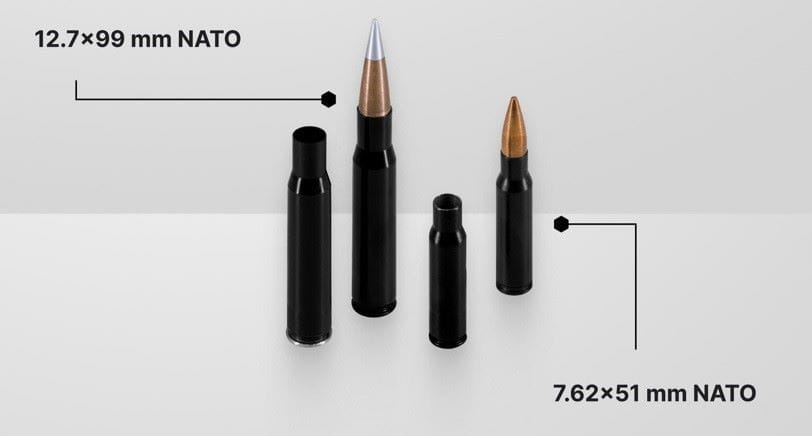
This is a significant advantage in logistics, as a pallet, truckload, or cargo aircraft carrying polymer-cased ammunition can transport substantially more rounds for the same weight, improving efficiency throughout the supply chain and making it easier to get the ammo to where it is needed.
But for ammunition manufacturers, the potential benefits extend beyond lower weight and include the following:
- Reusable: Designed to support up to three reload cycles while maintaining structural integrity and performance.
- Antistatic: Surface resistivity of 10⁶ Ω helps ensure safe handling, transport, and ammunition loading operations.
- Thermally Stable: Minimises heat build-up during firing, helping to maintain consistent performance.
- Hydrophobic: Water-resistant construction suitable for use in humid, wet, and maritime environments.
- Recyclable: Fully recyclable material design supports lifecycle efficiency, sustainability, and circular defence logistics.
- Lightweight: Up to 70% lighter than traditional metal shell casings, reducing the weight burden on soldiers and logistics systems.
From a manufacturing perspective, polymer-based casings may also offer greater scalability. As recent conflicts have demonstrated, ammunition consumption rates can exceed peacetime production capacity by a wide margin. Manufacturing systems that rely less heavily on metalworking and more on automated polymer processing could help increase production rates during periods of high demand.
In an era when ammunition stockpiles have become a strategic concern for many NATO countries, such innovations are attracting growing attention.
The Same Trend in Two Different Places
At first glance, 3D-printed boats and polymer ammunition appear to have little in common. Yet both technologies reflect the same underlying trend.
In both polymer ammunition and 3D-printed boats, advanced polymers are replacing traditional metallic materials. In each case, manufacturers are seeking to reduce weight while maintaining or improving performance.
The significance lies not simply in the materials themselves, but in what those materials enable. Lighter equipment reduces logistical burdens. Digital manufacturing accelerates production. Reduced dependence on metals can strengthen supply-chain security. Together, these advantages contribute directly to military readiness.
The result is a future where military technology may not be defined solely by smarter machines. It may also depend on what those machines—and everything around them—are made from.
AG Defense Polymers a.s. is a Czech nanotechnology and advanced materials engineering company that specialises in the research, development, and manufacturing of lightweight, high-strength polymer cartridge cases for military and defense applications.
Utilising proprietary, in-house developed nanostructured polymers, the company designs casing alternatives for a wide variety of small, medium, and large caliber ammunition—ranging from 7.62×51 mm and 12.7×99 mm NATO rounds to 40 mm grenades and large artillery shells (105/122/152 mm). By swapping traditional metal components (like brass or steel) with their advanced polymer matrices, they significantly reduce overall ammunition weight, decrease manufacturing costs, and simplify military logistics while strictly maintaining consistent ballistic performance.
If you would like to know more about what AG Defense Polymers can do, contact info@agdefensepolymers.com.
Photo credit: InterestingEngineering, Gencraft, & Gencraft